A Website Can Respond. That Doesn't Mean Its Information Was Retrieved.
In a bounded study of 245 business websites, HiveLuma established successful homepage retrieval for 93 of 107 attempted sites. For 138 sites, no homepage or information-file result was established under the study's conservative collection rules.
A website can be online and return a normal web response without telling us everything we need to know about whether its business information was successfully retrieved.
When a business asks “Can AI understand my website?”, there is an earlier question to answer. Was the information successfully retrieved in the first place?
We selected 245 business websites: 146 from a New York City business source and 99 from a York Region directory. Our research tool checked website access instructions, homepages and two types of information files.
A collection limit matters: at 138 websites, our tool did not establish results for the homepage or either information-file check. This happened mainly because of our conservative collection rules or problems obtaining the website's access instructions. It is not evidence that those businesses rejected AI agents or lacked capabilities.
How many homepages could our research tool reach?
- The study selected 245 business websites.
- The research tool attempted 107 homepages under its collection rules.
- Of those attempts, 97 returned a final HTTP response.
- Of those responses, 93 indicated successful webpage retrieval.
A final HTTP response is the website's reply after any permitted redirects. It may report success or an error. For sites without a completed homepage check, the outcome was not established by this measurement process. These numbers do not prove that an AI assistant understands a business, recommends it or can complete a purchase.
A successful web response and successful information retrieval are different measurements. Successful retrieval is still only one step before interpretation, recommendation or action.
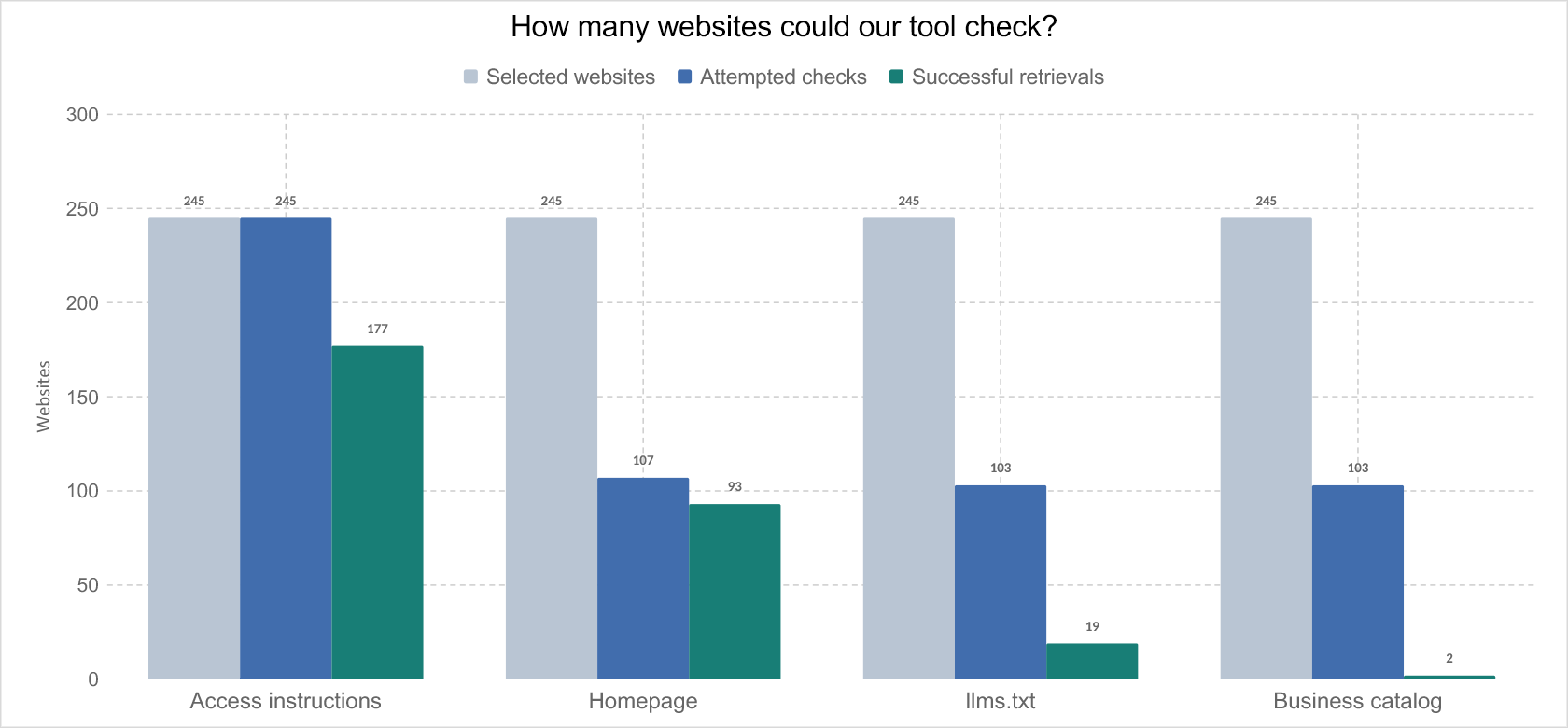
View this chart at full resolution
Scroll sideways to read the full table.
| Page or file checked | Selected websites | Attempted checks | Final responses | Successful retrievals |
|---|---|---|---|---|
| Website access instructions | 245 | 245 | 190 | 177 |
| Homepage | 245 | 107 | 97 | 93 |
/llms.txt |
245 | 103 | 88 | 19 |
| Business resource catalog | 245 | 103 | 85 | 2 |
What did the information-file checks establish?
The /llms.txt check
An /llms.txt file can list information for AI tools. We attempted this check at 103 of the 245 websites. There were 88 final responses, and 19 indicated successful retrieval.
We did not check whether those 19 responses contained valid or useful documents. They must not be counted as 19 businesses with proven AI-ready information.
The catalog check
We also checked a specific file path for a business resource catalog: /.well-known/ai-catalog.json. A catalog at this path can describe public resources in a machine-readable format; this is not a test of every possible catalog or information source.
Two responses indicated successful retrieval. Both failed the saved JSON syntax check, which tests whether a response follows the file format's basic writing rules. The original response bodies were not retained, so we cannot now inspect exactly what they contained.
Getting a reply, receiving a valid document and finding useful information are separate checks. None by itself proves that an AI assistant can complete a task.
Why were some checks not completed?
Before requesting the homepage or information files, our tool checked the website's access instructions. When those instructions could not be obtained or confidently interpreted, the tool stopped rather than assume permission.
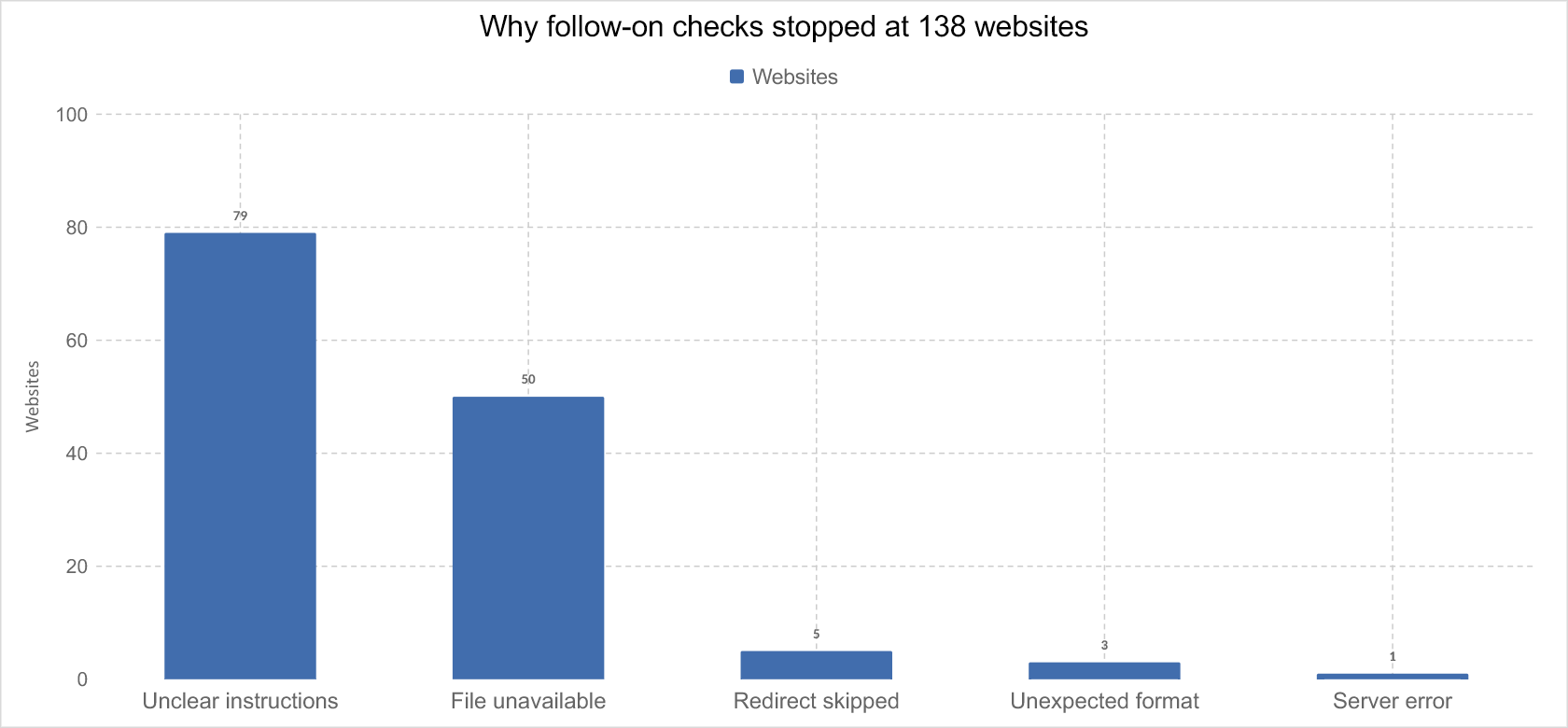
The same 138 websites had no established result for all three follow-on checks. The reasons below describe limits of our collection process, not the businesses' attitude toward AI.
View this chart at full resolution
Scroll sideways to read the full table.
| Collection limit | Websites | Share of the 138 affected websites |
|---|---|---|
| Access instructions our tool could not interpret | 79 | 57.2% |
| Access instructions our tool could not obtain | 50 | 36.2% |
| Redirect our tool did not follow | 5 | 3.6% |
| Access-instruction file had an unexpected content type | 3 | 2.2% |
| Website server error | 1 | 0.7% |
A redirect sends a request to another location. Our tool followed only redirects allowed by its safety rules. Rounded percentages may not add to 100%.
For 70 of the 79 interpretation stops, the tool reported an instruction pattern it did not support. Those instruction files were not retained, so their exact rules cannot now be reconstructed. That uncertainty must remain visible.
How much checking was completed?
The tool began checking all 245 websites. It reached its normal stopping point at 231. At 14, it stopped at our maximum of eight request attempts per website. This was a research safeguard, not a judgment about the business. Reaching a normal stopping point also does not mean every page or file was accessible.
The request log recorded 671 attempts, including redirects and attempts that ended without a website response. This does not tell us exactly how many requests reached website servers.
One unchanged analysis summary contains 670 because a recorded redirect was omitted from that summary. We retain both figures and use the request log for accounting. The methodology explains this difference and provides exact definitions, denominators and percentages.
What business owners can take from this
Make information clear and easy to find. Explain what your business does, who it helps and what it offers. Clear descriptions are a practical step to review, not a promise of more AI mentions.
Ask what was actually measured. Access asks whether a tool could retrieve something. Information quality asks whether it was clear, valid and relevant. Task success asks whether an assistant could meet a customer's needs. Each needs its own evidence.
What Would HiveLuma See on Your Page?
Page Scan attempts to retrieve a public page and reviews a bounded sample of the available written content for clarity and structure.
See what HiveLuma can retrieve from your page, review how clearly the page explains its key information, and decide which improvements are worth testing.
Use the review as a diagnostic aid. It cannot guarantee how every AI provider will interpret, rank, recommend or use the page.
What this study cannot tell us
This study examined what our research tool could retrieve from selected business websites. It did not test whether AI assistants would recommend those businesses, answer customer questions correctly or complete purchases.
The websites were selected for this research, not chosen as a random sample of all US or Canadian businesses. The US source was the NYC SBS Certified Business List; the Canadian source was the York Region Business Directory 2024. Source-list inclusion does not independently verify a business's current status.
Website access rules, collection limits, failed connections and unavailable response bodies affected what we could measure. The findings are historical observations, not proof of current website availability or business operation. We do not present a national adoption rate or rank industries by readiness.
Data and method: Read the methodology, download the endpoint counts, download the collection-limit counts, or view country and industry aggregates.