AI Named the Same Organization Two Ways. Would You Count It Once or Twice?
A small exploratory HiveLuma study shows why counting names returned by AI requires an identity step first — and why matching an identity still does not verify the claims attached to it.
Two AI answers used these names:
- “Business Development Bank of Canada”
- “Business Development Bank of Canada (BDC)”
Would you count them as two different organizations or one? Both names refer to the same bank. Counting different names for one organization separately can make provider agreement look lower. Checking what the answers said about the bank takes a second step.
Identity matching answers “Are these the same organization?” Trustworthiness and the truth of specific claims require separate evidence.
BDC's website identifies the bank and publishes a financial-management toolkit. The toolkit supports a claim about financial education, while the more specific claim about dedicated bookkeeping basics remains unverified. BDC's About page · Financial management toolkit
Read the study methodology and limits
What we asked
We chose small-business bookkeeping education and ecommerce operations education in Canada. For each topic we asked for organizations and people separately, with three runs of each question. The frozen design planned 36 operations across OpenAI, Anthropic and Gemini. The comparison covers OpenAI's GPT-6 Luna and Anthropic's Claude Sonnet 5. Gemini was included in the original study design but not in the formal comparison. One early Gemini reply was exploratory. The other 11 planned Gemini operations were not run. These findings do not assess Gemini's performance.
The questions asked for nominations. We did not request retrieval tools or check sources during collection. This small set of prompts cannot establish who the leading experts are, how often a business appears across AI tools, or which provider performs best.
How often did the two providers name the same organization or person?
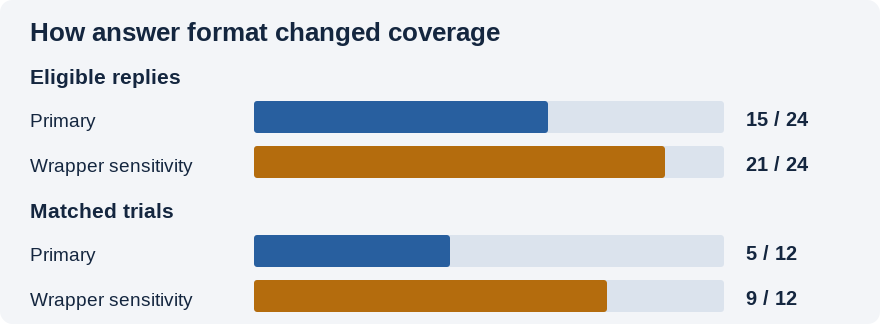
The primary rules yielded 15 eligible replies, including three valid empty lists. A matched trial needed an eligible answer from both providers for the same topic, type of nominee and repeat. Five of the 12 planned OpenAI–Anthropic pairs met that rule. Three of those five paired an empty list with a list containing names.
Scroll sideways to read the full table.
| Analysis | Eligible replies | Matched trials | Trials with at least one shared name |
|---|---|---|---|
| Primary rules, strict identity matching | 15 | 5 | 0 of 5 |
| Same primary replies, candidate aliases | 15 | 5 | 2 of 5 |
| Additional replies accepted in the format check, candidate aliases | 21 | 9 | 3 of 9 |
The last two rows show how the results change when we vary the rules. They do not replace the primary result. The missing pairs cannot be interpreted as disagreements.
The strict rule starts by requiring the same normalized name and type. It keeps variants apart when the evidence is too weak to join them. A separate check treated obvious acronym expansions as possible matches. That surfaced candidate overlap in both primary pairs where each provider supplied names. In one bookkeeping trial, those candidates included CRA, BDC and CPA Canada. In one ecommerce trial, they included BDC and CFIB. Official pages corroborate those name equivalences. The candidate counts still use the exploratory matching rules, and the official checks did not change the primary counts. CRA · BDC · CPA Canada · CFIB
Answer format also mattered. Six saved replies put their list under an entries label, and two of those lists were empty. An offline check applied the same row requirements to the lists inside that wrapper. It raised the count to 21 eligible replies and nine pairs. We made no new AI requests for this check.
Who Does AI Name in Your Market?
Trusted Names compares the distinct people, businesses and organizations returned by configured AI providers for a topic or market.
See where providers return the same identities, where they differ, and review available source observations separately.
The results show observed provider responses. Authority, trustworthiness and expertise require separate evidence.
What did the source checks establish?
The models supplied a URL in four of 58 primary nominations. The other 54 nominations had no URL. These are counts of nominations, so one organization can appear more than once. A missing URL makes a statement harder to trace. A supplied link may identify the organization without supporting the description.
- Canada Revenue Agency and CRA refer to the same agency. Its business-records guidance explains what to keep for income and expenses. The page supports that specific description. CRA business records
- CPA Canada and Chartered Professional Accountants of Canada refer to the same organization. Its publications support a claim about financial-literacy education, including material for small businesses. The pages we checked leave the specific claim about a public bookkeeping course open. CPA Canada program overview · Small-business podcast transcript
- Shopify and Shopify Compass are related names that describe different things. Shopify's 2021 announcement describes Compass as an education program. We kept the company and program separate and did not establish current Compass course availability. Shopify's historical description
What a business owner can take from this
If an AI answer mentions your business under two names, start by checking whether both names point to the same organization. Then look for a page that supports what the answer said. An About page can help with the first check. A specific resource page often helps more with the second.
Method and limits
Twenty-five operations were consumed across the original three providers. Nine of the 24 OpenAI and Anthropic attempts were outside the primary comparison rules, including one historical reply whose completion could not be verified from the retained record. One other historical reply qualified for the primary analysis based on its saved completion and model evidence. It contributed no matched trial.
The source review used 12 official pages for six selected examples. It did not check every nominee or claim, establish a gold-standard list, or measure the effect of a mention on business outcomes. Results describe these questions, models, answer formats and matching rules.